Sunday, March 29, 2009

Cogeneration Increases Again

Some of my correspondents bitterly cling to the idea that nuclear-generated power is cheaper by far than any other form of generation.  They cannot believe, nor understand, that cogeneration is vastly superior.   Below is an excerpt from a March 23, 2009, news release showing that cogeneration continues as an economically viable and superior technology.  

"ANTWERP, Belgium--ExxonMobil today inaugurated its newest high efficiency cogeneration plant at its Antwerp refinery in Belgium. Cogeneration is the simultaneous production of electricity and useful heat or steam used for industrial processes. In addition to generating 125 megawatts, the new plant will reduce Belgium's carbon dioxide emissions by approximately 200,000 tonnes per year, the equivalent of removing about 90,000 cars from Europe’s roads.

"Energy efficiency is one of the most effective tools available for reducing greenhouse gas emissions," said Sherman Glass, president of ExxonMobil Refining & Supply. "Since 2004, ExxonMobil has invested in over 1,500 megawatts of cogeneration capacity in five countries."

With the inauguration of the Antwerp facility, ExxonMobil now has interests in about 4,600 megawatts of cogeneration capacity in about 100 individual installations at more than 30 sites around the world. This is enough capacity to supply the needs of more than 5 million homes in Europe.

"This new cogeneration plant allows for the efficient generation of electricity to run pumps, compressors and other equipment in our facilities, while at the same time, producing additional steam that is needed in processes that transform crude oil into refined products," said Gilbert Asselman, manager of the Antwerp refinery.

"With the latest technology, cogeneration is significantly more efficient than traditional methods of producing steam and power separately. This results in lower operating costs and significantly less greenhouse gas emissions."

Additional new facilities under construction in Singapore and China will increase ExxonMobil's cogeneration capacity to more than 5,000 megawatts in the next three years."

In fact, as more unsubsidized nuclear power plants are built, grid power prices go up and up.  The incentives for industry to  install cogeneration also increases.   As not many recognize, the steam from a cogeneration plant need not be used for heating or reboiling or stripping uses, although those are the most common.  When the grid power prices are sufficiently high, steam is used to drive turbines, rather than electric power to energize a motor.   This is commonly found in complex chemical plants and refineries, where a pump driven by a motor has a spare pump driven by a turbine.  The operator can easily switch between the two, depending on whether electric power or steam is more financially attractive.  

Further, the smaller-scale devices that are suitable for hotels, apartment houses, commercial buildings, and even individual homes become much more attractive as the costs of grid power increase.  

ExxonMobil just built a cogeneration plant in Antwerp, Belgium.   Europe is famous for having much of its power generated by nuclear plants, yet apparently the power is not so cheap that cogeneration is uneconomic.  

Roger E. Sowell, Esq. 

Contact Mr. Sowell at his legal website.


Friday, March 27, 2009

Intro Environmental Science versus Reality

This is the first posting of what will likely be a long effort, my deconstruction and refuting the numerous illogical, skewed, and biased arguments found in a college textbook on Environmental Science.  This particular one is Third Edition, by M. L. McKinney and R. M. Schoch.  

I read through this book, and answered a few questions that were asked to me by a student taking the class who had to use this book.  The student knows I am a chemical engineer and environmental attorney, and wanted clarification on several subjects.  I was happy to answer his questions.  The questions made me curious, and I read the book with growing dismay at the level of distortion and blatant agenda of the authors.  Each of the major points, and quite a few minor points, I will give in these blogs, with my response based on facts.  The students who take these classes are bright, and are eager to understand and learn, but it is giving them an unfair and biased view of the world to let them see only one side of the issues.   Most students will not learn about the other side or sides, for one reason, they do not have the curiosity, for another, they trust college professors to teach them the truth, and for another, even if they are skeptical and have the curiosity, they do not have the time.   I hope this series of blogs is helpful in those respects. 

I will start at the beginning, on page 5, where it is asserted "many environmentalists consider human population growth, or, more precisely, the impact of humans on the environment, to be the single most important issue that the world currently faces."   The authors then have a diagram, showing interactions of humans with the environment (lithosphere, biosphere, hydrosphere, and atmosphere).  They further state that "raw elements of the natural environment pass through human society to produce the global environment in which we currently live.  For all practical purposes, there is no pristine wilderness remaining anywhere on Earth."  

This is very misleading, if not outright absurd.  Is it true that many environmentalists consider the impact of humans on the environment to be the single most important issue the world currently faces?  No doubt, there are many in that camp who would agree.  But that leaves off the more important questions, doesn't it?  Questions like attacks from terrorist groups, threats from new diseases, threats from impacts of asteroids, threats from major solar eruptions, threats from super volcano eruptions, and the cataclysmic threat from the sudden breaking away of a portion of the Hawaiian island that will result in a titanic tsunami of more than 1000 feet height.   The relative impacts of each of the threats listed above would show that impact on the environment is not nearly as important as the others.  

As to no pristine wilderness existing anywhere on Earth, that is far from the truth.  I have had the good fortune in my life to travel to many places on the Earth, and seen firsthand many of its areas.  Northern Canada is very pristine.  So is much of Alaska.  The Grand Canyon has a few trails, but the vast majority is pristine.  The jungles and subtropical areas of Brazil are virtually untouched.  The fact is that most humans live within a few miles of a coast.  The interior of most continents are sparsely settled.  North America, particularly the U.S.A. is well-developed, but vast areas of Australia, China, Russia, and South America are essentially pristine.  

Next, the authors assert that man's depletion of environmental resources is one of the two types of environmental disturbance.  The other type is discharging waste into the environment.  Further, the authors state that environmentally friendly ways to address these problems are explored, meaning ways to utilize resources productively without pollution and environmental damage.    I will come back to this as a recurring theme, to provide balance to the discussion. 

The authors then mention a very bleak post-industrial age that will occur unless man lessens its detrimental impact on the environment.  This shows a level of hopelessness and disregard for man's abilities that I will attempt to put right. 

Next comes an assertion without foundation or facts to back it up:  that cleanup of waste and pollution are the most expensive way to solve environmental problems.  Next they assert that a holistic approach is needed that will be much better and less expensive.  Again, no factual backup is provided.  

The real complaint that environmentalists have is stated next, those being 1) human population is too high, and 2) resource consumption, or material goods is too high.   This is the recurring theme throughout the book, that if only we could remove some or most of those horrible humans, the rest of us would be so much better off!  And secondly, even after removing most of those horrible humans, we must reduce the consumption by those remaining humans.  Are these authors advocating eugenics, to kill off undesirable people?  If so, by what yardstick are humans to be measured for the decision on remaining alive, or being killed?  And, what material goods are to be allowed, and who decides, and who enforces this?   

The authors go on to assert the Big Three of the environmentalists' mantra: Reduce, Reuse, and Recycle.   By Reduce, they mean that the amount of natural resources must be reduced, that is, the flow of resources used by mankind.  By Reuse, they mean using something more than once rather than throwing it away.  And by Recycle, they mean convert a used item into a new item, rather than placing the used item in a landfill then mining more natural resources to produce another similar item.   Each of these Big Three are fundamentally flawed, and I will discuss this. 

Reduce.   One example given in the book is that logs are cut in sawmills, which is wasteful because sawdust cannot be used as lumber.  This is very misleading, because few wood products today are made from solid wood.  Only very few, and very expensive items are solid wood.  Most are wood veneers, a thin layer of wood that is peeled from a log using a specialized wood peeling machine.  The veneer is attached to a backing made of plywood.  The plywood is made from wood chips and an adhesive.   Where saws do cut wood, the sawdust is collected and pressed into shapes such as a fire-log for fireplaces.   The inconsistency is apparent, as environmentalists want to ban wood-burning fireplaces due to the smoke and CO2 emissions, yet if left in the forest, the trees will die and decompose into CO2.  

Reuse.  An example of reuse is to use metal eating utensils rather than plastic ones.  The idea is that metal knife, spoon, and fork can be washed and reused, but plastic ones will be thrown away after one use.    Another is to substitute worn-out tee-shirts for paper towels.  Rather than buy paper towels, one is to use an old tee-shirt that can be washed with other clothes.   The absurdity soon appears, as the same people advocate not washing clothes until a full load accumulates.  Otherwise, the thinking goes, one is wasting water and energy while washing a partial load.  Therefore, one should wipe up a kitchen spill with the old tee-shirt, and toss it into the laundry basket for a few days until wash day arrives.  This is highly unsanitary and would lead to health issues, not to mention smelly odors.   It is far better to buy and use a paper towel, and throw it away to maintain proper health and hygiene. 

Recycle.  This is the well-known means of discarding waste goods into separate containers that can be collected and taken to recycle centers.  In many areas, recycling containers are provided by the city or town for paper, glass, plastic, and metal.  Some go so far as to have containers dedicated only to aluminum cans such as soft drinks.    What many people do not realize is that recycling has little impact on raw material usage.  With paper, for example, there is a glut or overabundance of used paper that cannot be recycled.  The reason is that many paper products will not function properly if too much recycled paper fiber is added.  Another is glass.  Recycled glass cannot be used for many purposes because of purity issues.  Plastic also cannot be recycled into the same products, but sometimes can be made into other products.   Finally, metals are not all the same and separating them can be very costly.  

Next, the authors gloss over one of the most discredited positions of environmentalism:  the exponential growth rate.  They even mention two of the books that were gross exaggerations, and predicted outcomes that never came to pass and likely never will.  The Population Bomb by Ehrlich, and Limits to Growth by the Club of Rome.  According to the Population Bomb, the world was to reach its limit of humanity by some years ago, which clearly did not happen.  The Club of Rome book, Limits to Growth, was equally wrong in all its predictions.  It predicted exponential growth in several key areas, all leading to the destruction of mankind.  One was population, another energy use, another raw material use, another water use, another was financial capital, and finally the growing mountain of pollution or waste.  Not a one of these came to pass.  

The facts are quite different.  Food never ran out, as was predicted, instead we pay farmers to not grow food to prevent price collapses.  Water has never run out and never will, as it is cleaned up in the oceans and recycled naturally by the heat of the sun and falls as rain or snow.   Resources not only have not disappeared, they have actually grown less expensive over time, indicating an abundance rather than a shortage.  Population is not growing exponentially, in fact, many countries are shrinking in population.  Japan recently issued a request for its citizens to go make babies.   A wonderful book on the population growth topic is America Alone.  

Thus ends the first installment.  

Roger E. Sowell, Esq. 

Sunday, March 22, 2009

Late Winter Storms

California, where I live and work, is getting hammered again today by a winter storm.  This is a big one, as the adjacent map shows.  The storm extends from Washington State south through Southern California, and east into Arkansas, up to Michigan.   This is roughly two thirds of the U.S. 

In California, this storm is bringing rain to the lowlands, plus snow to the Sierras, which will melt later and become very welcome fresh water in a time of drought.   But it is also bringing cold temperatures, resulting in my running the furnace in my humble abode.   

How things have changed since I first moved to Southern California 23 years ago.  My interview day was around February 1, 1986.  It rained that day.  My future colleagues assured me, almost apologetically, that this was very unusual and there would be no more rain for the next 9 months.  Being from Dallas, and before that Houston, this was out of my range of experience.  It rains frequently in those two Texas cities.   Yet my colleagues' words were prophetic, and it indeed did not rain again until November.  

Now we have rain plus snow on the 22nd day of March.    The high temperature for today in Los Angeles is expected to be 59 F.  The normal for today is 70 F.  

A word to all the global warming alarmists, and the climate change proponents, especially those who fervently believe that man's activities are the cause, or culprit.   Many of us, like me, are paying very close attention, collecting and archiving data.   I am highly skeptical of man's part, if any, in the slow warming and cooling of the earth's atmosphere.   Part of my skepticism arises due to wholesale adjustments to measured temperatures from the past, by those particularly at NASA under James Hansen.  It is telling that the adjustments were broadly downward for data before about 1965, then broadly upward since.   The impact is to increase the upward slope of the time-vs-temperature curve.  Hmmm...this is a slap in the face to all the good people who took the time to carefully look at a thermometer, then write down their reading and report it to others.  

Roger E. Sowell, Esq. 


Friday, March 20, 2009

A Waste of Taxpayer Dollars on Solar

In Southern California, where I live and work, the government agency in charge of the air quality is the South Coast Air Quality Management District.  We just call it the AQMD.   They regulate all sorts of things, such as refineries, dry cleaners, cement plants, basically anything that creates air emissions and does not have wheels.  Even then, the wheeled emitters can fall under their jurisdiction if the wheels do not roll for more than 12 months.  This includes things like portable (wheeled) generators, even portable concrete batch plants.  

AQMD tries to lead by example at times, by employing green technologies at their headquarters, for example, and using compressed natural gas (CNG) for its fleet of business vehicles.  They have lots of cars for their inspectors to drive around, inspecting things. 

From their website, they are installing still more solar panels on the roof of their very large headquarters building in Diamond Bar, just east of Los Angeles.   Their website crows about their saving $24,000 per year in not purchasing electric power, as the solar photo-voltaic (PV) system will generate power for them. 

What they are spending is $780,000, and what they are getting is 80 kilo-watts of generation.  These are special, new PV systems, that will generate power even in less-than-full sunshine.  Even at 8 hours per day, 365 days per year, and an avoided power cost of $0.10 per kwh, the system will barely reduce the electric bill by $24,000 per year.  At that rate, it will require 33 years to break even on the investment.  

But, AQMD claims that the system will break even in 15 years.  This is due to state rebate money paid to them, and likely due to higher power price instead of the $0.10 I used above.   At peak times of the day, their power price could be $0.20 per kwh, thus giving a 15 year break even time.   They also state that the time to break even could be much shorter, if power prices increase.   Well, here's the deal.  The power company only charges the very high rates during the summer season, not all year.  That is because cooler weather does not force the power company to run the high-cost peaker power plants, essentially just a gas turbine with a generator spinning on one end.  Those only are fired up on the hottest days of summer, when the air temperature soars to 90 F or more.  

Ah well.  It is money that has at least SOME return on investment. It could be spent in worse ways, I suppose.   But, if a business had to choose this investment, or putting the money in the Standard and Poor's 500 Index fund, they would do far better with the index fund.  It pays around 10 percent per year, over the long term.   The PV project pays 2.9 percent, even with the 15 year payout.   To achieve the same return as the stock market, the power price for power avoided by the PV project must be $0.35 per kwh.   And that is for the full 8 hours, every day, 365 days per year. 

Even in California, where the state mandated that 33 percent of all power sold by 2020 must be from renewables, that will take some doing.   For some perspective, the present cost of electric power for a residence is $0.11 per kwh, unless one consumes more than the allotted amount.  Then, the power price can reach $0.20 or even $0.30 per kwh, but only for the amount over the allotted.   For a commercial facility such as the AQMD headquarters, the power price is just over half what a homeowner pays. 

And to be fair, AQMD may have little choice in the matter.  The state of California has mandated that all government facilities spend tax money to cut their utility bills.  So, these sorts of 30-year payout projects are sprouting all over public buildings in California.   Mind you, these expenditures are in addition to all the other social services that are funded.  Meanwhile, the state budget deficit grows and grows.  It was $42 billion up until a few weeks ago, when it was miraculously reduced to zero by a combination of tax-increases, service cuts, and massive borrowing.  However, just this week the deficit reappeared in the amount of $8 billion.   Is there any connection between the massive spending on solar panels, and the huge deficits?  

Roger E. Sowell, Esq. 
Contact Mr. Sowell at his legal website

Sunday, March 15, 2009

California MayDay MayDay MayDay

Again from WattsUpWithThat.com, a commenter using the handle Squidly responded to a statement I made earlier.   So I responded thusly:  [my additional comments are in brackets]


@ Squidly (22:50:50) :

“Roger, do you really believe that California’s economy could pick up by then? I sure hope it can and does, but I don’t share your optimism. I think California’s economy is basically toast for a very long time. But, on the other hand, if it does, I am sure you are correct that the AGW crowd will attempt to either take credit for it, or use the improvement to minimalize the impact of their “green” policies. I really feel for Californian’s right now. I believe they are in for a very rough road ahead.”

I do not believe California’s economy will pick up any time soon. Our eternal state budget woes just keep increasing. Yet, many residents seem to have confidence, witness real estate buyers who continue to pay $600,000 for an average, 3-bedroom 2 bath home with 1700 square feet. Without an ocean view.  [a good friend has a home in Thousand Oaks, a small bedroom community of 100,000 residents where the big employer is Amgen.  The prices I gave are from zillow, and in an average neighborhood there.]

A few make it big in the movies, and that road to destruction (boulevard of broken dreams) lures people here by the thousands. [although California no longer has a monopoly on movie-making; animated films and CGA (computer generated art), plus state tax incentives for movie producers to film elsewhere make the balmy California weather less of a factor. Still, the wanna-be's keep showing up, taking jobs as waiters and waitresses, going to the "right" clubs and the "right" parties, hoping to be given a part in a movie.  Like Las Vegas, where a jackpot occurs every few minutes to remind the slot-players that it IS possible, and could happen to them next, Hollywood keeps anointing a very few each year.]

The things I watch are the unemployment numbers (most important), and budget deficit (second most important), then the status of California’s bonds. As long as California can sell bonds to mortgage the future, the state has little incentive to cut spending. If and when the state defaults on its bonds, the place will collapse overnight. [the bond rating agencies have recently cut California's bonds to the lowest rating of all 50 states, including perennial cellar-dweller Louisiana.   Ronald Reagan would be so proud (NOT) ]

It is said that what starts in California soon infects the rest of the country; well, I hope the rest of the U.S.A. has enough sense not to follow the “tax and spend and borrow the rest” attitude that has placed California in this predicament.  [although judging from the federal lunacy of print-and-spend, calling it various things like Bail-Out, Stimulus, with justifications like "XYZ is just too big to be allowed to fail" it appears California is just riding the current fiscal trend.]

Several negatives are about to happen one after another. When Obama’s EPA allows California’s exemption for automobile tail-pipe CO2 emissions, we will not have very many new cars to buy. So the auto dealerships will go broke, and the auto repair shops will boom. The EPA is expected to grant the exemption in early April or May. [cars today cannot be repaired at an affordable price, as they were designed to fall apart after 4 to 5 years operation.  The average consumer is then faced with a horrible choice:  buy a new car or newer used car with very high payments, or repair the current car knowing that it will just keep breaking down.  Further, car makers do not have many cars that meet the strict new California standards.   This is an interesting situation:  what will the State of California do, when the law says new cars must meet XYZ standards, but the car makers do not make such cars?]

The state tax increases on sales, and gasoline, and personal income, will decrease per-capita personal spending. Many more companies will fail, close their doors, and put people out of work.

The state’s Low Carbon Fuel Standard, LCFS, part of the AB 32 lunacy, will increase gasoline and diesel prices.

The RPS (Renewable Portfolio Standard), which requires 20 percent of all electric power sales in California be from renewable sources by 12/31/2010, will also increase power costs to everyone. The amount is uncertain, but will likely be around 10 to 20 percent. [the price increase could be much more in hot weather, when the wind does not blow and there is not much solar generation installed]

The state minimum wage keeps increasing, it is $8 per hour now, yet major cities have an even higher “living wage” requirement. This is great in the short term for the minimum wage-earner, but it keeps many people unemployed.

Finally, if the special election in May succeeds in changing the state’s rules for passing a budget, California is done. Currently, a budget requires 2/3 vote to pass the legislature. The new rule would require a simple majority vote.

Then it will be tax and spend, baby. No drill, baby, drill. Just tax, baby, tax, and spend, baby, spend. The California “experiment in socialism” should end with a bang. But, the curious thing is that tax-and-spend voters far outnumber the others. And the media spin-machine convinces the tax-and-spend voters that other people, the rich people, will pay the taxes, not them.

There is a gubernatorial election in 2010, and our Governator Scharzennegger is already a lame duck in many respects. The only viable candidates are far more to the tax-and-spend side than he is/was.

This is not going to be pretty.


Roger E. Sowell, Esq. 

Contact Mr. Sowell at his legal website

Saturday, March 14, 2009

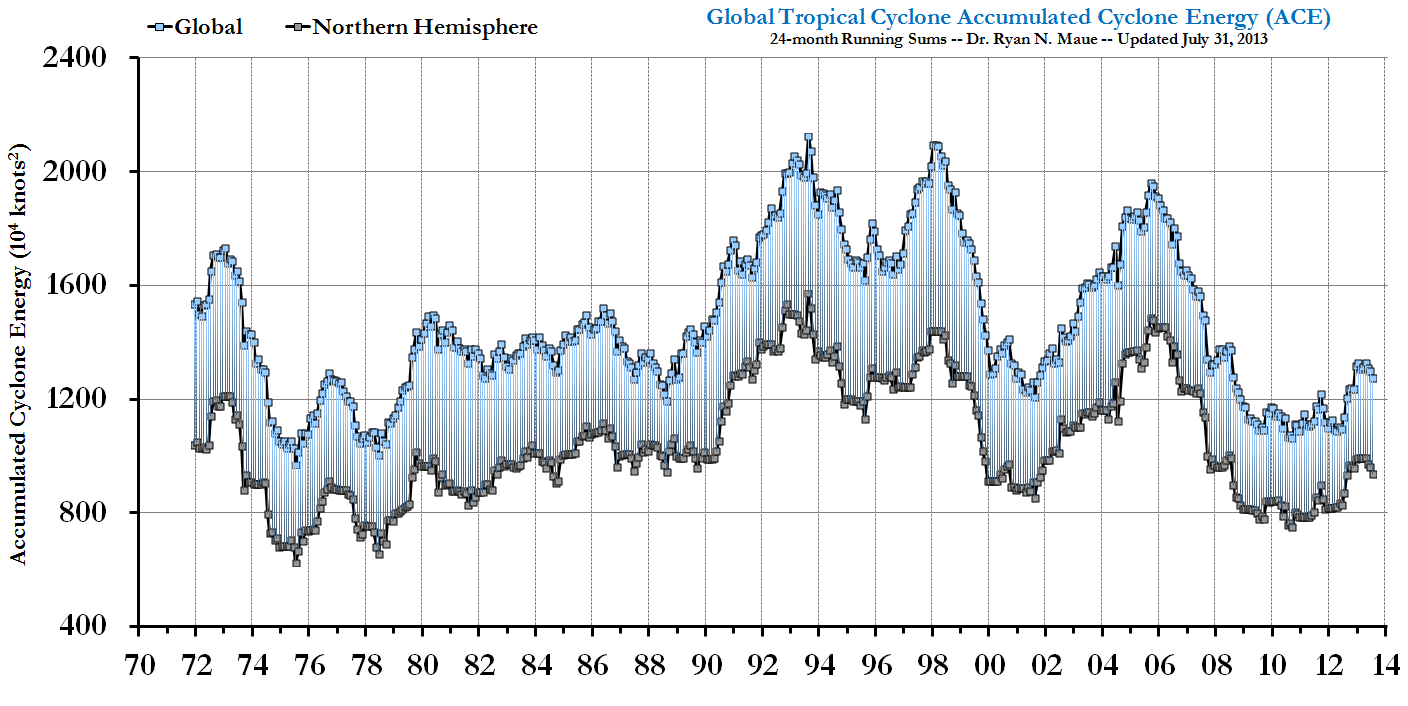
Global Cooling: Hurricanes Getting Weaker

One of the primary dire predictions of the AGW crowd (anthropogenic global warming, now known as Climate Change) is that hurricanes and tropical cyclones will grow in number and especially in intensity as the man-made CO2 increases in the atmosphere.  The increased CO2 is supposed to reflect or re-radiate thermal energy onto the earth's surface, and warm the oceans.  

Warm ocean water tends to increase formation of hurricanes and tropical cyclones.  So, what does the measured data show?  The AGW warmists claim that the globe's temperature has increased dramatically since 1975, along with CO2 in the atmosphere.  They claim the increased CO2 is primarily due to man's consumption of fossil fuels such as oil, coal, and natural gas.  

As the graph above shows, average hurricane and tropical cyclone energy did increase from 1974 to about 1992, but has been declining ever since.  By March of 2009, the most recent point on the graph, the metric is lower than at any time since 1974.  

How can this be, when CO2 has been constantly rising over the period?  The data for CO2 in the atmosphere, measured at Hawaii's Mauna Loa observatory, shows continued increase in CO2. 

Once again, the underpinnings of the global warming alarmists are shown to be false.  

Every legislator, whether in California, other states, or at the federal level, should take this into consideration.  The claims of Al Gore, James Hansen, and the other AGW alarmists are just not true. 

A responsible legislator would immediately draft legislation to repeal any global warming laws already on the books, such as AB 32 in California.  For global warming laws in the works, a responsible legislator would vote NO, and argue persuasively for his/her colleagues to do the same.  

We need responsible laws based on demonstrable science, not economy-wrecking laws based on unsupportable supposition.  

Roger E. Sowell, Esq. 
Contact Mr. Sowell at this site.

California Budget Crisis -- Again

The news from Sacramento, California, yesterday stated the state is facing an $8 billion shortfall.  This follows the marathon budget-fix conducted only three weeks ago, in which taxes were"temporarily" increased $12.5 billion, state services decreased $15 billion, and federal stimulus plus borrowing bridged the gap remaining for a total of $42 billion.   That $42 billion is by far the greatest state budget deficit in the nation.  
 
At this rate, $8 billion per month, California will be in the hole by $100 billion one year from now.  (ok, it will only be $96, but I rounded up). 

So, what can we expect from the Sacramento lawmakers this time?  Will it be more tax increases?  Probably.  Will it be more services reductions?  Not likely.  Will it be more borrowing to bridge the gap, and to be repaid sometime in the future with tax revenues collected at that time?  Well, maybe, if anyone steps forward to purchase the debt -- that is, lend California their money.  

The economy is grinding along, with the sand in the gears making louder and louder shrieks.  Unemployment increases weekly.  Traffic declines as the formerly employed stay at home, watching the tv and cruising the internet.   My daily commute gets better and better.  Same distance, less time required.  Better gas mileage, too, since there is less stop-and-go.   Hey, maybe there is a silver lining here?  

The lines at the grocery store where I shop for sustenance are growing longer and longer, while the restaurants' parking lots have fewer and fewer cars. 

Schoolteachers in California yesterday received 'preliminary pink slips' to notify approximately 29,000 teachers that they will need to seek other employment, and soon.  

What was it we heard in the 60's on the pop radio stations?  

And the hits just keep on coming.